

Home to hiking trails, inspiring retreats, and archaeological discoveries, Ghost Ranch is working to conserve its stunning landscape for future generations. By Julian Dossett
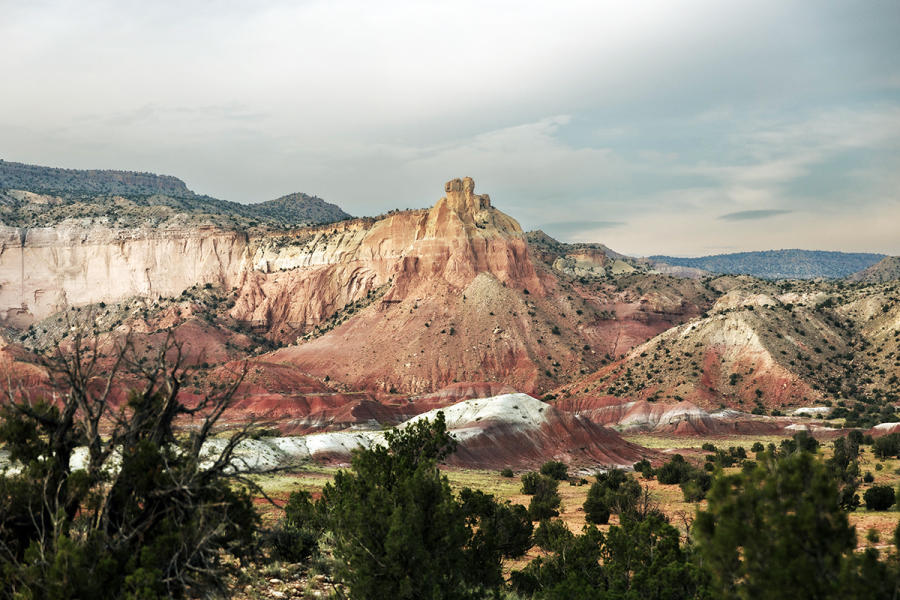
Halfway to the iconic Chimney Rock spire, the thin trail meanders up a gentle embankment and sweeps out to the west. Far below, the cars crawling along the distant highway look like ants. The windy desert plains that spread from the highway for hundreds of acres mark the vast conservation project now underway at Ghost Ranch, where American modernist painter Georgia O’Keeffe lived and painted many of her most celebrated works.
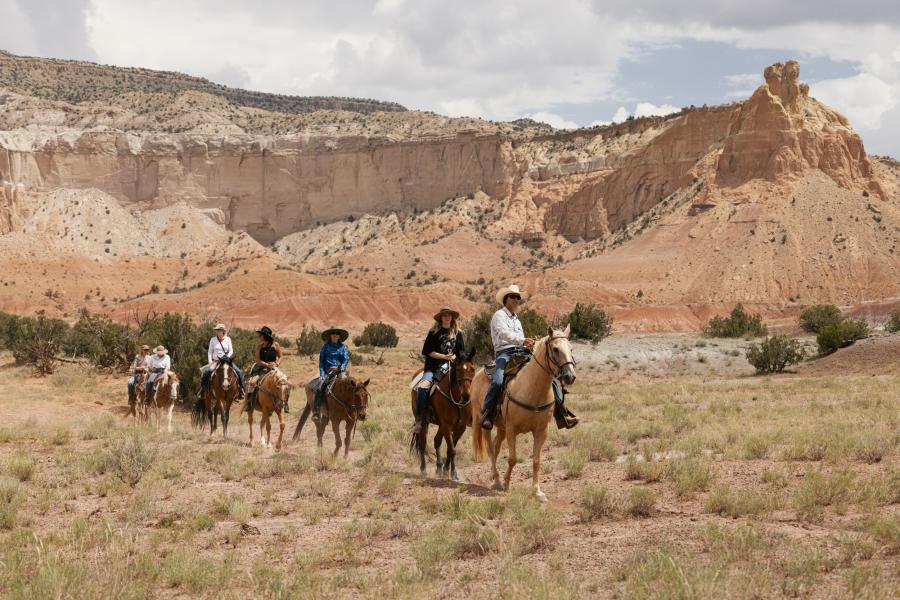
Thousands of visitors make the journey to Abiquiú each year to experience these painted cliffs and inspiring landscapes. They can enjoy an activity-filled day of hiking, horseback riding, and paddle boarding; learn more about O’Keeffe and her work through a guided tour; book an overnight stay and take in glowing sunsets and star-filled skies, or participate in one of the many multiday workshops. You can easily spend an afternoon wandering the pair of adjacent museums a stone’s throw from the ranch-style education and retreat center, where Native artists and jewelers often sell their work on the weekends.
“When you come down our road, you’re enveloped by this magical canyon and the red cliffs shooting up,” says David Evans, CEO of the Ghost Ranch Education & Retreat Center. “I just want people to be able to feel that, and that magical feeling is what we want to preserve forever.”
This is why the people who live and work here have come together with the State of New Mexico and New Mexico Land Conservancy to develop a plan aimed at protecting this place in perpetuity. The project will preserve 6,000 pristine acres of wildlife habitats and waterfront along Abiquiú Lake, while ensuring sustainable operations for Ghost Ranch’s educational programs.
As the midday sun casts deep shadows over Piedra Lumbre Valley’s red and yellow cliffs, I walk back down the trail, taking in a landscape that drew people long before O’Keeffe found her way here.
Indigenous cultures thrived in this region some 10,000 years ago. Archaeological excavations around Ghost Ranch have unearthed some of the artifacts they left behind. Similarly, Ghost Ranch has also become well known as a site for paleontology from the Triassic period, a dynamic eon when dinosaurs roamed the landscape. Nearby quarries have revealed fossilized skulls, bones, and other vertebrates from dozens of reptiles and amphibians. The education center’s two museums—the Florence Hawley Ellis Museum of Anthropology and the Ruth Hall Museum of Paleontology—delve into this fascinating history.
The anthropology museum features well-preserved artifacts, pottery, and wall-mounted displays and maps documenting the archaeological digs, so visitors can better understand the research. In neighboring rooms, there’s also newer work. Ghost Ranch has partnered with local artists from nearby pueblos to showcase contemporary art in a variety of mediums and styles.
The museum’s back door opens to a small courtyard, and painted blue dinosaur prints lead to the paleontology museum, where the main attraction is a large composite-cast skeletal mount of a phytosaur—a crocodile-like reptile that lived about 150 million years ago. It stands in a diorama display of the time period, complete with a surrounding mural of a prehistoric lake and forested shores.
The museums help orient visitors and enrich their understanding of Ghost Ranch as they explore a wide variety of activities. The 21,000-acre property hosts a range of programs and workshops throughout the year, like watercolor painting, astronomy, and meditation. Ghost Ranch offers wellness experiences like sound baths, Reiki, and massages. Overnight guest accommodations include tent and RV campsites, basic cabins, hotel-style suites, and historic cottages.
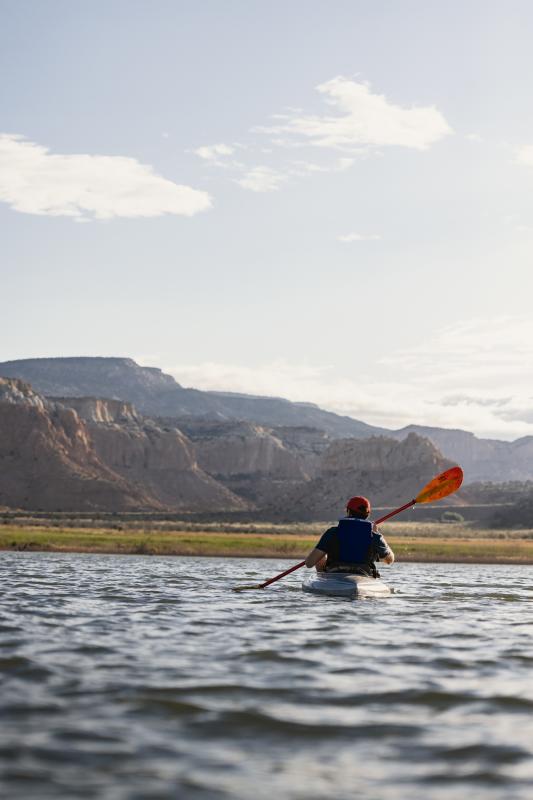
Of course, the stunning nature surrounding Ghost Ranch will always be the reason why people visit. This is why the conservation plan is of utmost importance, Evans tells me. To get an up-close view, he suggests heading out to nearby Abiquiú Lake, which borders the conservation project, for a canoe, kayak, or paddleboard experience. Now that Ghost Ranch’s breathtaking views will be preserved forever, Evans says, “you and your kids and your grandkids and their grandkids are going to have the same experience.”

