

For almost 30 years, the Spencer Theater has brought internationally acclaimed live shows to New Mexico.
The Spencer Theater for the Performing Arts, in Alto, might be the only place on Earth where visitors can see a herd of elk wander across a high-mountain mesa and then watch a big-budget stage production, touring musician, or children’s theater performance in an intimate setting.
“I’ve heard people say that it’s the end of the rainbow,” says executive director Charles Centilli, who has worked at the theater since it opened in 1997. “It’s a magical experience.”
Known as the Carnegie of the Southwest, the theater was the dream of Jackie Spencer. Her first husband, Capitan cattle rancher Hugh Bancroft Jr., was an heir to the Dow Jones/Wall Street Journal publishing fortune. When he died in 1953, she became one of the country’s wealthiest citizens. Because Spencer loved the performing arts, she wanted to bring high-caliber performances to Lincoln County, where she lived and raised her three children.
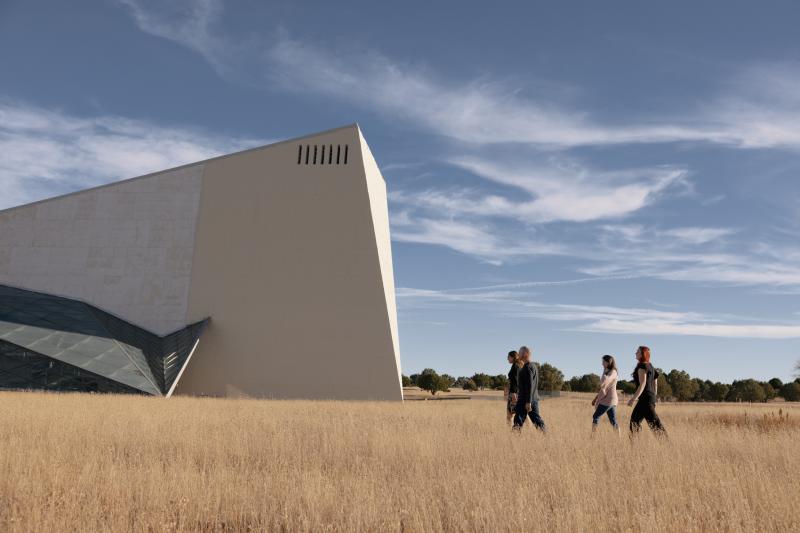
In the mid-1990s, Spencer contracted Albuquerque architect Antoine Predock to create a theater on the grassy Fort Stanton Mesa that runs between Sunset Peak and Sierra Blanca, about 12 miles north of Ruidoso. The smooth, wedge-shaped building rises from the basin floor, drawing inspiration from the landscape and designed as a tribute to the relationship between earth and water. “The building forms a peak at the western edge, mirroring the mountains that surround it,” Centilli says. “Predock created a cascading waterfall on the east side of the building that splashes down into a reflection pool.”
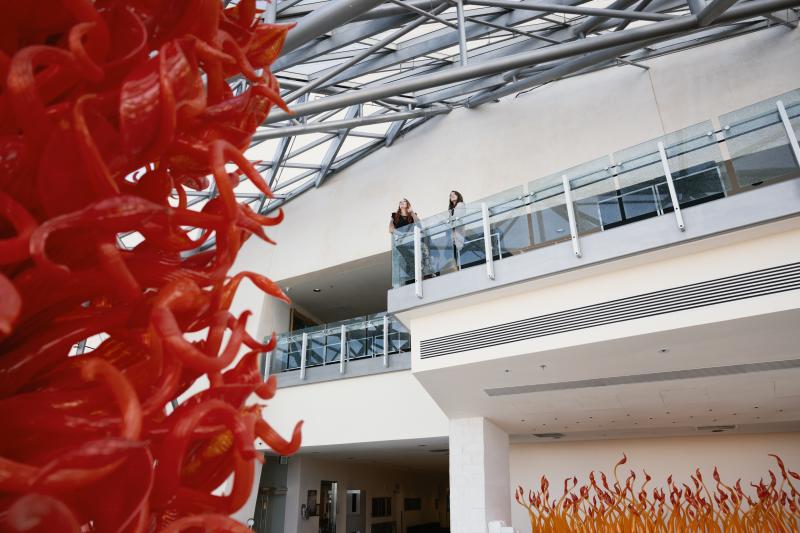
The geometric glass structure on the north side of the building, which looks like a huge diamond growing from a mountainside, serves as the entryway and lobby for guests. “The Crystal Lobby atrium really accents the entire structure,” Centilli says. The see-through walls are made up of 354 unique facets of glass, giving visitors an expansive view to “enjoy the entire surrounding landscape, from the mountains to the New Mexico night skies,” he adds.
Many of the Spencer Theater summer and winter performances begin with a dinner two hours before each show. “You can enjoy food prepared by our executive chef William Wilson and hospitality staff on-site,” Centilli says, noting that they plan each meal so guests have time to get to their seats before the show.
The lobby balcony provides access to a second-floor overlook, where deer, elk, and wild horses can often be spotted roaming the area. “We often say we wish we could sell tickets to the wildlife,” Centilli says.
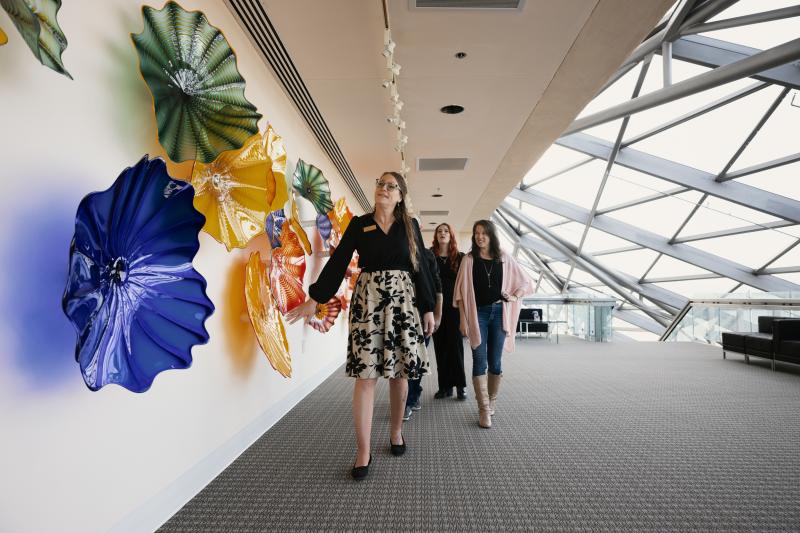
The Spencer is also home to one of the largest private collections of works by famed glass artist Dale Chihuly in the Southwest. The Seattle artist’s stunning works of handblown glass include Glowing Sunset Tower, a 564-piece sculpture of squiggling red and orange bows that rises 14 feet in the lobby; Indian Paint Brushes, inspired by the wildflowers of New Mexico, in the atrium; and The Persians, a bright, 36-piece display that is part of Chihuly’s most popular series. (Guided tours are available to see Chihuly’s artwork and the unique architecture on Tuesdays and Thursdays at 10 a.m.)
With 514 seats, the intimate box theater includes balcony seating on both sides and a stage equipped with an orchestra pit. The 30 or more shows the Spencer Theater hosts every year cover almost every type of live performance. On any given night, you might catch a Broadway musical, symphony, ballet, country and western act, flamenco, or comedy, with most tickets ranging from $59–$79.
The theater remains a labor of love for Centilli and the entire staff. Pulling off large, complicated stage productions in a performance space tucked away in rural New Mexico comes with plenty of challenges. “It’s that constant stress and pressure of not being able to defer the curtain,” he says. “If something happens, you’ve just got to make it work. The curtain’s got to go at eight o’clock, no matter what.”
But in the end, it’s worth it. “When you see people leave with those smiles and happiness, that’s the reward,” Centilli says. “That’s why you do it, and that’s why we’re here.”

